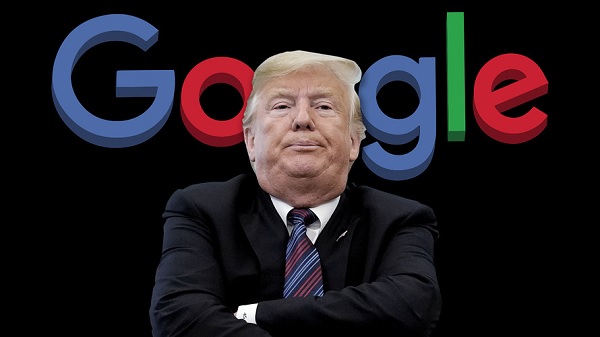
Latest Trump assault on free speech: He wants to control Google searches
It should come as no surprise that Donald Trump, a man with a history of assault against the First Amendment — especially free speech and freedom of the press — that he has been using his second term in office to seek revenge against Google and other companies he doesn’t care for due to their failure to bow to his magnanimousness.
Perhaps Americans should have taken his promise to be a “dictator on day one” and exact revenge on his political enemies just a little bit more seriously (via RawStory.com):
President Donald Trump is attempting to control your Google search results, according to a Newsweek column written by the founder and CEO of Chamber of Progress, Adam Kovacevich.
Trump’s move could be considered taking advantage of an antitrust lawsuit against the firm, which started during the Biden administration.
In 2024, Judge Amit Mehta ruled against Google, claiming the company “monopolized key digital advertising technologies,” meaning they held a monopoly on internet search engines. This year, the case has reached the “remedies stage.”
Kovacevich claims Trump’s DOJ is not making the process about competition but instead, “as a vehicle to punish Google for exercising its free speech rights.”
“Never mind that the actual case says nothing about speech or censorship,” Kovacevich remarked, “To Trump’s administration, this is about control, not market share. And they’re pulling every lever they can to make sure this case ends the way Trump wants.”
Kovacevich believes the latest remedies being proposed “would put Trump appointees directly under the hood of Google’s search engine for the next three to six years.”
The remedies would let Trump “hand-pick a five-person ‘technical committee’ with broad control over Google’s business and products for a decade.”
“Imagine Googling ‘Donald Trump’ and seeing only glowing coverage,” the CEO said, “If that sounds far-fetched, it shouldn’t.”
He warned, “We’ve already seen what Trump does with power: he punishes critics, installs loyalists, and bends once-independent institutions to his will.”
Kovacevich added, “Now, the president stands to gain unprecedented influence over the world’s most powerful information tool.” (Emphasis mine)
The 2024 ruling mentioned above is significant in the timeline of Trump’s plans concerning Google.
During a FOX Business interview with Maria Bartiromo during his 2024 campaign, Trump went on a tirade about unfavorable news coverage of the alleged assassination attempt made on his life and issued a threat against Google to that he might “shut down” the media giant for being “very bad” to him and his campaign. Specifically, he accused the media giant of blocking some results related to the assassination attempt.
After praising Facebook representatives for calling him and apologizing for flagging posts featuring photos of his assassination attempt with fact checks, Trump said, “Google, nobody called from Google,” and then proceeded to issue his threat (via Salon.com):
“Google has been very bad. They’ve been very irresponsible. And I have a feeling that Google’s going to be close to shut down, because I don’t think Congress is going to take it,” the former president told Bartiromo. “I really don’t think so. Google has to be careful.”
Toward the end of the Fox segment, he also mulled stripping Google of its Section 230 protections and praised Elon Musk and X, as Musk throws cash behind a PAC supporting his re-election bid. (Emphasis mine)
This was not an isolated incident; Trump issued a similar threat against Google during his first term.
In August 2018, Trump used one of his worn-out “Fake News” cliches in a tweet to accuse Google of showing “only the viewing/reporting of Fake News Media” whenever someone searched “Trump News.” He went on to say, “In other words, they have it RIGGED, for me & others, so that almost all stories and news is BAD, Fake CNN is prominent. Republican/Conservative & Fair Media is shut out. Illegal.”
Further, Trump accused Google [and] others of “suppressing voices of Conservatives and hiding information and news that is good [and] controlling what we can and cannot see.” And he concluded by saying: “This is a very serious situation – will be addressed.”
This was not an empty threat. Trump’s economic advisor at the time, Larry Kudlow, said in an interview with reporters that the administration is “taking a look” at the possibility of regulating Google searches.
Taking down companies like Google and unfavorable news and social media outlets is part of Project 2025 and Agenda 47, as I documented in an article, Project 2025 and Agenda 47: Donald Trump’s plan for a police state.
Both of these documents call for granting Trump dictatorial power to shut down free speech and rein in the free press, beginning with a renewed emphasis on expanding libel laws to make it easier to sue media outlets for spreading “fake news.” Suing media outlets has been fundamental to Trump’s ego-driven ambitions from the beginning of his 2016 campaign and continued throughout his presidency.
Donald Trump has always demonstrated a clear hatred of the Constitution because of the limits it places on the power of the presidency and big government. Nowhere was this more evident than in his self-declared war against the news media, or as he repeatedly called it, the “enemy of the American people,” and his repeated threat to sue them out of business.
Illegal? Will be addressed? What does that mean? Why aren’t the orange Kool-Aid drinkers bothered by such rhetoric? I know. Stupid question.
Trump’s mention of stripping Google of Section 230 protection — Section 230 of the Communications Decency Act protects online platforms from certain liabilities for user posts and moderating decisions — is another threat that should be taken very seriously.
Section 230 “reform” was attempted in the waning days of Trump’s first term with help from Attorney General Bill Barr and a few members of Trump’s bought-and-paid-for Republican Party to take down the First Amendment, punish political enemies, and give government more control of the internet . . . mafia style.
From January 2018 to August 2018, Trump renewed his threat to expand libel laws so he can sue news outlets for writing “bad things” about him, promoted the creation of state-run media, and threatened to revoke credentials for media outlets that reported negative stories about him.
In August 2019, Trump proposed issuing an executive order given the Orwellian politispeak title: “Protecting Americans from Online Censorship.” The order called for the FCC to create new rules to determine when Section 230 should apply and when it shouldn’t. This was the motivation behind Lindsey Graham
Trump wasn’t acting alone in this arena; he had the Trumpist Republican Party doing their part to help him along. For example, in January 2020, Lindsey Graham introduced the Eliminating Abusive and Rampant Neglect of Interactive Technologies (EARN IT) Act. The EARN IT Act was designed to give government complete authority to grant . . . or deny . . . Section 230 protection for social media platforms based on their “compliance” with a set of arbitrary and capricious rules established by the government.
Donald Trump has made his intentions known to all, and if he has his way, he will seize control of Google and turn the media giant into an arm of his propaganda machine. That is, after all, exactly what a dictator would do.
 David Leach is the owner of the Strident Conservative. He holds people of every political stripe accountable for their failure to uphold conservative values, and he promotes those values instead of political parties. He the author of The New Axis of Evil: Exposing the Bipartisan War on Liberty.
Follow the Strident Conservative on Twitter and Facebook.
Subscribe to receive podcasts of his daily radio feature: iTunes | Pandora | Tune In | iHeart | RSS
For media inquiries or to have David speak to your group, use the Contact Us form.

2 comments for “Latest Trump assault on free speech: He wants to control Google searches”