As predicted, Trump’s tariffs and trade wars are causing inflation
One of the major failures Donald Trump’s first term in office was his economic policies and the trade war hell he created by imposing massive tariffs that caused inflation and started a recession that reached its zenith during the so-called pandemic caused by COVID.
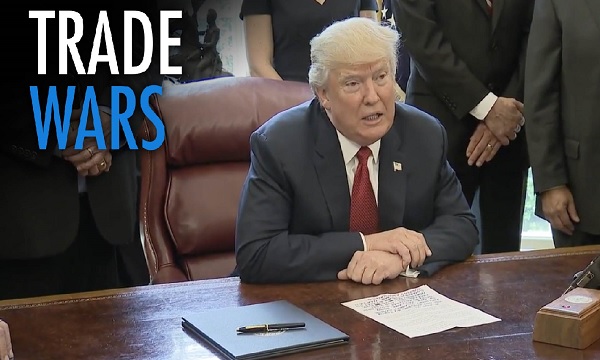
Unfortunately, Donald Trump is using his second term in office to double down on the use of tariffs as a key weapon in another trade war against pretty much the entire globe. But this time, he could be creating an economic hell that will make his first term look like a walk in the free-market park (via APNews.com):
Inflation rose last month to its highest level since February as President Donald Trump’s sweeping tariffs push up the cost of everything from groceries and clothes to furniture and appliances.
Consumer prices rose 2.7% in June from a year earlier, the Labor Department said Tuesday, up from an annual increase of 2.4% in May. On a monthly basis, prices climbed 0.3% from May to June, after rising just 0.1% the previous month.
The uptick in inflation was driven by a range of higher prices. The cost of gasoline rose 1% just from May to June, while grocery prices increased 0.3%. Appliance prices jumped for the third straight month. Toys, clothes, audio equipment, shoes, and sporting goods all got more expensive, and are all heavily imported.
“You are starting to see scattered bits of the tariff inflation regime filter in,” said Eric Winograd, chief economist at asset management firm AllianceBernstein, who added that the cost of long-lasting goods rose last month, compared with a year ago, for the first time in about three years. (Emphasis mine)
In a piece I wrote shortly after the 2024 election, I documented the failures of Trade War I and how Trade War II would produce the same failed results.
Trump officially launched Trade War I in January 2018 when he placed tariffs on solar panel and washing machine imports, causing significant and immediate price increases. Later, in March 2018, Trump placed across-the-board tariffs on steel and aluminum, a move directly and immediately responsible for doubling the price of steel on US manufacturers and price-gouging by steel providers.
Facing minor backlash for these actions from then-Sen. Ben Sasse and Sen. Mike Lee, Trump assured America that “trade wars are good, and easy to win.” He went on to say that “the steel industry is in bad shape” even though over 70 percent of the steel used in America at the time came from America.
Unfortunately, it turned out that trade wars weren’t all that good nor easy to win because the economic damage inflicted by Trump’s tariffs was evident during his first term in office, beginning at the one-year anniversary of their use.
Samsung North America CEO Tim Baxter said in a January 2019 interview with FOX Business that Trump’s tariffs had a negative impact on the prices of Samsung products.
“The industry actually ended up after the imposition of the section 201 [tariffs] about a $100 price increase on literally all laundry products. So, a category that was growing with the GDP is actually contracted in 2018.” (Emphasis mine.)
According to estimates made by the National Taxpayer’s Union Foundation at the time, the total annual cost of Trump’s tariffs on consumers was $41.65 billion, an amount that exceeded the taxes Americans had paid for Obamacare ($34.6 billion).
When his first attempt at reelection in 2020 was clearly failing, two years of Donald Trump’s trade war had turned out just as predicted: the farm industry was decimated, manufacturing was in a recession, and 100% of the cost of tariffs had fallen directly on American businesses and consumers.
We later learned in 2021 after he was no longer in office that Trump’s tariffs and trade wars had a devastating impact on consumer prices and the economy (via Reason.com):
Those tariffs … are adding roughly 0.5 percent to annual inflation across the economy. That’s the conclusion drawn by Ed Gresser, a former assistant U.S. Trade Representative who is currently the vice president and director for trade and global markets at the Progressive Policy Institute, a center-left think tank. Trump’s tariffs on washing machines, solar panels, steel, aluminum, and a host of Chinese-made goods are a “secondary but noticeable contribution” to overall inflation right now, Gresser writes.
That’s pretty much in line with what four economists at the San Francisco Federal Reserve warned in February 2019, shortly after Trump began slapping tariffs on various goods. “Imports from China are an important part of overall U.S. imports of consumer and investment goods,” they wrote. “Thus, tariffs on these imports are likely to have sizable effects on consumer, producer, and investment prices in this country.”
The one and only thing that tariffs do is raise prices. That is their only function. Politicians might want to deploy tariffs (to raise prices) for a number of reasons: to protect domestic industries, to influence where in the world individuals choose to invest, to retaliate against what they perceive as unfair trade practices from other countries, and so on. But all those goals—and tariffs are poor ways of accomplishing most of them—are second-order functions. To the extent that any of those things occur, they happen because tariffs raise prices. (Emphasis mine)
Despite the overwhelming evidence of the damage Trade War I tariffs had inflicted on the US economy, some of the talking heads in the so-called conservative media have endorsed Trade War II and latched on to the hyperbolic “economic success” nonsense coming from Trumpists:
“Trump-induced retardation” is an interesting use of words considering how Deace was adamantly opposed to Cheeto Jesus before accepting him as his economic lord and savior. But alas, Trumpism replaced conservatism over at BlazeTV much like it has the Republican Party itself.
Trump promised in 2016 that tariffs would shrink the trade deficit, but an October 2020 Department of Commerce report documented how they had caused the trade deficit to reach a record high at the time while also destroying over 300,000 jobs. He also promised to reduce the deficit by reducing spending (a promise he made again in 2024 and has already broken with his Big Beautiful Bill).
Reducing Congress’ spending addiction is a significant broken promise because it is a bigger driver of inflation than Trump’s tariffs and trade wars.
Unfortunately for Trump and his army of sycophants, the truth of the matter is that his tariffs and trade wars created an economic hell that only grew worse with his tyrannical response to COVID and the trillions of dollars he and the Republican Party spent to stimulate the economy. There’s plenty of evidence to show how Trump’s economic policies got the ball rolling, but his handling of the COVID “pandemic” finished a job that America still hasn’t recovered from.
Donald Trump’s irrational and erratic economic policies mixed with his egomaniacal narcissism did serious harm to the economy, and that’s simply the truth behind tariffs and trade wars.
 David Leach is the owner of the Strident Conservative. He holds people of every political stripe accountable for their failure to uphold conservative values, and he promotes those values instead of political parties.
Follow the Strident Conservative on Twitter and Facebook.
Subscribe to receive podcasts of his daily radio feature: iTunes | Stitcher | Tune In | iHeart | RSS
For media inquiries or to have David speak to your group, use the Contact Us form.